
We were delighted to welcome Mike Roe, Tensense CEO and guest speaker Margaret Heffernan recently for the second webinar in this year's Tensense.ai series titled 'Steering Through Uncertainty - Leadership in a Turbulent Era'.
Thank you to everyone who joined us, and we hope you enjoy watching as much as we enjoyed participating.
To follow on from the webinar, here Mike Roe shares his thoughts on the main takeaways and considerations of the webinar video.
Tomasz Wiklinski asked the pertinent question, “How did the writing of “Wilful Blindness all start”? The answer, the Enron crisis and Margaret’s role in the aftermath. She was fascinated as to “how could such a situation be allowed to occur?” This stimulated her to think about other organisations and similar outcomes.
For over a decade Margaret Heffernan has visited the Bath Fifteen, a mentoring group for CEOs and entrepreneurs. Every year she spends a morning with a group of senior leaders and shares stories of her research, experiences and the contribution of data to make the world a better place. Normally she scares everyone to death and then provides some hope and optimism. What is true, is she helps our members stay ahead of the game, remain curious and ask themselves powerful questions about their organisations and their personal leadership.
As CEO of Tensense.ai, I love Margaret, not just because of her extraordinary insight and ability to communicate difficult messages, but the alignment between her stories and our purpose. This was why I was keen to introduce her to IAPA members via the recent webinar.
Although I lead a software company, the passion is the contribution Tensense.ai data makes to inspire leaders and organisations to be the best they can be. The data gathered by Tensense.ai does the heavy lifting, providing the insights necessary for leaders to predict performance and augment decision making. Leadership is still a “contact sport”.
Margaret made so many critical points I would strongly urge you to watch the webinar below and then, if your curiosity is peeked, look at the two books referenced here.
The complexity faced by leaders requires a new and more creative approach by leaders who need to know what’s really going on in their organisations. Margaret makes the point that leaders cannot hope to absorb everything and need to develop a “warning system” that surfaces the emerging threats and opportunities.
In Dubai, we shared the case study from Armstrong Watson. Having now collected even more data Toby Woodford (CTO) will now states “Tensense helps me predict our profitability in two months’ time.”
Margaret will say, in addition to a predictive capability, leaders need to move to “preparedness”. What we know for certain is that there will always be something that comes from left field and throws us off course; made worse if we don’t prepare.
That is why (and this might be axiomatic for accountants) the ability to forecast is now not much beyond 400 days, and it is only 400 days if we are really good at forecasting! This is not to decry planning and forecasting. The 3-year plan still has a place, but it must be viewed as more of a “sketch” than “reality”.,/span>
Margaret’s next book will be published soon and will focus on the need for organisations to be far more creative in their thinking over the next 20 years. More so than we have ever been before. You will read about the “Supreme Sensemakers”, the artists. Artists, whose approach to their work keeps them ahead and their improvisation allows them to adapt and react. Looking forward to reading this.
Martin asked about the relevance to current events such as the emerging crisis at Harrods. This raises the same themes; who knew, why didn’t they act, what stopped some sensible and ethical sound individuals calling it out? When Harrods was purchased by the current owners, a lot of due diligence would have been spent on the numbers, less focus on the culture and what people really knew was going on!
So, in summary, how do we prepare our organisations for a cultural shift to a more creative and innovative future? How can we avoid “organisational silence” and make sure the vociferous minority are heard? We partnered with IAPA because I think we can play a part in this challenge. We work closely with Margaret because she helps inspire leaders to think and act!
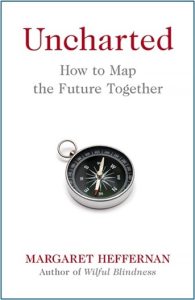
In February 2020, Margaret Heffernan's Uncharted was released, highlighting society's unpreparedness for uncertainty—just as Covid-19 struck. The pandemic exposed our reliance on predictive technology and the inability of institutions to adapt when plans fell apart. Yet, some, like Ford and DACS, successfully adapted by embracing flexibility and creativity.,/span>
Heffernan argues the pandemic is part of a larger need to rethink how we live and work in an unpredictable world. Drawing from diverse fields, Uncharted offers insights into thriving through creativity and adaptability. Revised for 2021, it advocates moving beyond "prediction addiction" towards preparedness.
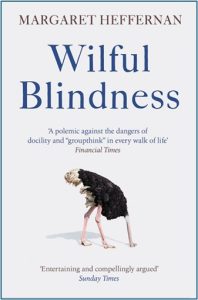
Fully revised since its 2011 release, this updated edition of "Wilful Blindness" includes new examples like Grenfell Tower, Carillion, Harvey Weinstein, and Windrush. Heffernan argues that the greatest dangers are often those we ignore—not because they're hidden, but due to wilful blindness. She explores why we prefer ignorance, what fears drive this behaviour, and why some see more clearly than others. Using examples from the Catholic Church, SEC, Nazi Germany, BP, and others, the book shows how ignoring obvious issues can ruin lives and collapse organisations, while offering strategies to counteract this tendency.