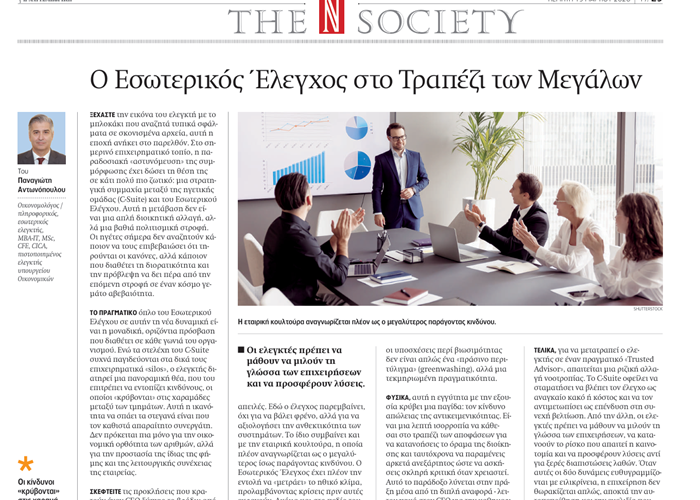
Auditors must learn to speak the language of businesses and offer solutions. As reported by Panagiotis Antonopoulos and shared by member firm Orthologismos.
Panagiotis continues:
FORGET the image of the controller with the pad looking for typical errors in dusty files; this era is a thing of the past.
In today's business landscape, the traditional "policing" of compliance has given way to something much more vital: a strategic alliance between the leadership team (C-Suite) and Internal Control.
This transition is not a simple administrative change, but a profound cultural shift.
Leaders today are not looking for someone to reassure them that the rules are being followed, but someone who has the insight and foresight to see beyond the next turn in a world full of uncertainty.
THE REAL weapon of Internal Control in this new dynamic is the unique, horizontal access it has in every corner of the organization.
While C-Suite executives are often trapped in their own business "silos", the auditor maintains a bird's-eye view, allowing him to identify risks that are "hiding" in the cracks between departments.
This ability to break barriers is what makes him an indispensable partner. It's no longer just about the financial correctness of the numbers; it's about protecting the company's own reputation and operational continuity.
THINK about the challenges that keep a CEO awake at night: from the explosive and often uncontrollable rise of AI to labyrinthine cyber threats.
Here, the audit intervenes, not to put the brakes on, but to assess the durability of the systems. The same is true of corporate culture, which is now recognized as perhaps the biggest risk factor. Internal Audit now has the mandate to "measure" the moral climate, preventing crises before they explode.
Even in the realm of ESG, where the pressure for transparency is suffocating, leadership relies on scrutiny to ensure that sustainability promises are not just a "greenwashing" but a documented reality.
OF COURSE, this proximity to power hides a trap: the risk of losing objectivity. It's a delicate balance to sit at the decision-making table to understand management's vision and, at the same time, remain independent enough to criticize harshly when needed.
This paradox is solved in practice through double reporting – functionally to the CEO for day-to-day action and administratively to the Audit Committee to ensure impartiality.
ULTIMATELY, to turn the auditor into a true "Trusted Advisor", a radical change of mindset is required. The C-Suite must stop seeing control as a necessary evil or cost and treat it as an investment in continuous improvement.
On the other hand, auditors must learn to speak the language of businesses, understand the risks required by innovation, and offer solutions instead of dry findings of error.
When these two forces align honestly, the business is not just shielded; it gains the confidence and agility needed to dominate global competition.
To learn more about orthologismos: CLICK HERE
To view orthologismos's profile: CLICK HERE
Article by: Panagiotis Antonopoulos
Economist / IT specialist, internal auditor, MBA-IT, MSc, CFE, CICA, certified auditor of the Ministry of Finance.
Source: Naftemporiki